
Cultural Analysis in Practice
Mieke Bal on Narratology and Image-Thinking
A conversation
Mieke Bal is a cultural theorist, critic, filmmaker, video artist, and curator whose work spans narratology, semiotics, visual culture, contemporary art, feminism, psychoanalysis, and migratory culture. She was Professor of Theory of Literature at the University of Amsterdam, where she co-founded the Amsterdam School for Cultural Analysis (ASCA), and served as Academy Professor of the Royal Netherlands Academy of Arts and Sciences from 2005 to 2011. A recipient of numerous honorary doctorates, she was appointed Knight of the Order of the Netherlands Lion in 2017 and elected an International Honorary Member of the American Academy of Arts and Sciences in 2023.
She is the author of some fifty books, including Narratology: Introduction to the Theory of Narrative, which grew out of De theorie van vertellen en verhalen: Inleiding in de narratologie (1978), was subsequently published in English in 1985, and is now in its fifth edition. Other books include Quoting Caravaggio: Contemporary Art, Preposterous History (1999); Travelling Concepts in the Humanities: A Rough Guide (2002); Narratology in Practice (2021); and Image-Thinking: Artmaking as Cultural Analysis (2022). Instead of writing a conventional autobiography she came up with an ABC of memories and theoretical concepts for Moments of Meaning-Making: On Anachronism, Becoming, and Conceptualizing (2025). Her latest book in German, Über das Versuchen (2026), is also discussed in our present conversation.
Alongside her theoretical writing, she has developed an extensive practice in film and video installation. Her body of work includes Becoming Vera (2008), A Long History of Madness (2011), Madame B: Explorations in Emotional Capitalism (2014), Reasonable Doubt (2016), and the multi-channel installation Don Quijote: Sad Countenances (2019). Her films and installations have been exhibited internationally. In 2017 she curated Emma & Edvard: Love in the Time of Loneliness at the Munch Museum in Oslo.
In this conversation, we begin with the relationship between Mieke Bal’s foundational work in narratology and her later practice of image-thinking as cultural analysis. Moving through her films and installations, we consider art’s capacity to “speak back”; the ways trauma can disrupt narrative form; and how migration, cultural difference, and non-linear temporality complicate stable ideas of identity and belonging. We also discuss her engagement with psychoanalysis and the social production of madness, before returning to the reciprocal relationship between theory and artistic practice, and to art’s capacity to respond critically across time.
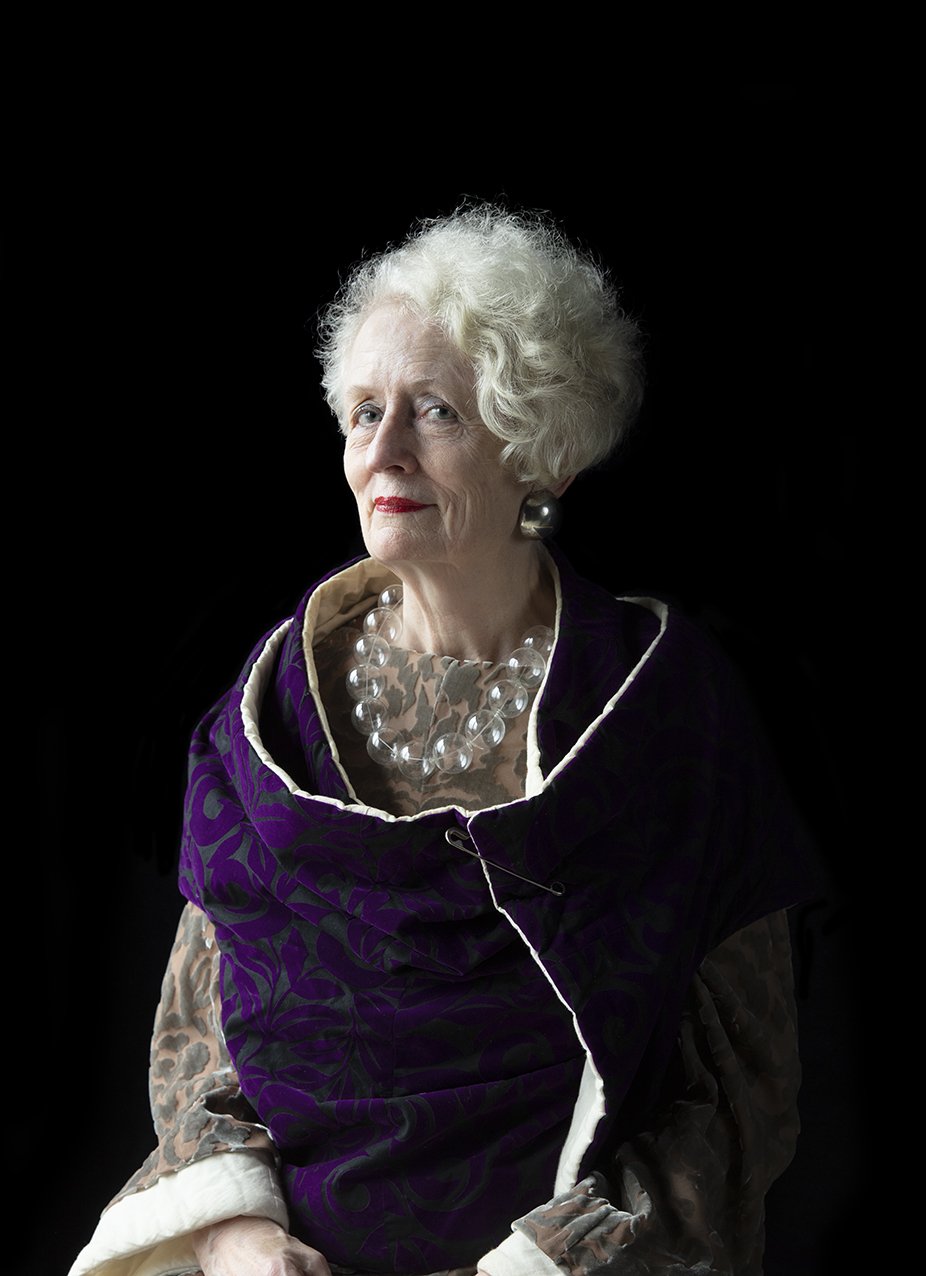
Portrait of Mieke Bal
Photographer: Carla van de Puttelaar
Still of actor Sly Maceo Sampimon from the film REFUGEEDOM: LONELY BUT NOT ALONE, by Mieke Bal and Lena Verhoeff, 2022-23.
Abstract Essay film 24.43’, colour, Dolby sound, voice-over but no dialogue.
Courtesy of the artist.
Mieke Bal: Thank you for bringing these two books up together. It matters! Narratology is my oldest, the other one my newest — more or less. The older one articulates the theory of narrative as I had developed it in line with, but nevertheless, in some respects critical of, Gérard Genette, in his 1972 book Figures III, in which he uses Proust's À la recherche du temps perdu as his primary example. And the later one demonstrates in what that can result when a careful, precise analysis is done in (artistic) practice. Image-Thinking responds to a challenge I felt when my documentary video-making, with which I started, ended up in "theoretical fictions". There, I responded to — but did not "adapt" — masterworks from cultural heritage. The difference between responding and adapting is precisely the difference between activated reactions and what used to be considered a passive, contemplative "public".
For me, film is one of the many possible media that can facilitate, and can produce narrative. So can literature, theatre, opera, figurative and even abstract artworks. Although it is often deployed to construct and present narratives, it is not essential, hence, always leading to, narrative. Film is a medium for the production of, but not being by itself, narrative. A medium is a vehicle, a means to do something, and in my film and video work that frequently results in stories, or at least, contents that seem to be narrative, or contain narrative fragments. However, the divisions of longer films into parts that can be installed as exhibitions, which we have frequently practised, makes the narrative quality sometimes a bit dubious. Especially in the installation Don Quijote: Sad Countenances, which responded to Cervantes's famous literary text, the mode of installing responded to the novel's incoherent narrative — an incoherence that was, according to us as makers, triggered by trauma — by setting the screens in a very disorderly way, avoiding rows. Thus, we questioned the linear narrativity and thereby responded to the literary text with its profoundly messy (non)structure.
But I have never given up on the analytical precision I have been pursuing in my five editions of the Introduction to the Theory of Narrative — a book that started as a sequel of my PhD from 1977 (now about 50 years old). I believe the precision I have constantly been pursuing was meant to do justice to the literary narratives from which I started. But yes, it helps the analytical result to enrich the experience of the work's "second persons": in the first place, readers and/or viewers. The practice I describe in Image-Thinking demonstrates that, I hope. Hence, as your question suggests, the distinction between your two articulations can indeed be considered dissolved if my filmmaking practice convinces viewers; or rather, compels them to act as participants, activated as they are by the curatorial creativity through which the pieces of art can work — as I phrase it. With that phrase, I was following Michael Ann Holly's latest book, where she transforms the term "artwork" into "the work of art", turning a noun that indicates an object into an activity, a verb, that is meant to be enhancing the activity of art. I think it is especially the combination of the concepts of space and focalization, which are both so crucial in exhibitions that induces an active, responsive "second personhood" of the participants to become temporarily "first-persons" — speaking back, as it were, to the way the art enticed them to active responses. For me, this reversal of roles is key to the processes that exhibitions are meant to encourage.
Chennie Huang: Narratology: Introduction to the Theory of Narrative is a book you wrote and have revised since its first publication in the late 70s. In it, you established a narratological framework centered on three analytical levels — text, story, and fabula. Within that framework, and in story, you developed concepts like focalization, temporality, and space as indispensable instruments for understanding how narrative produces meaning. In Image-Thinking: Artmaking as Cultural Analysis (Edinburgh, 2022), you dissect elements of your own films and art installations, testing the coherence of theoretical concepts you established in Narratology. Do you regard the medium of film primarily as a narrative method that generates analytical insight, or as an analytical instrument that necessarily takes narrative form? Perhaps the practice of image-thinking dissolves that distinction?
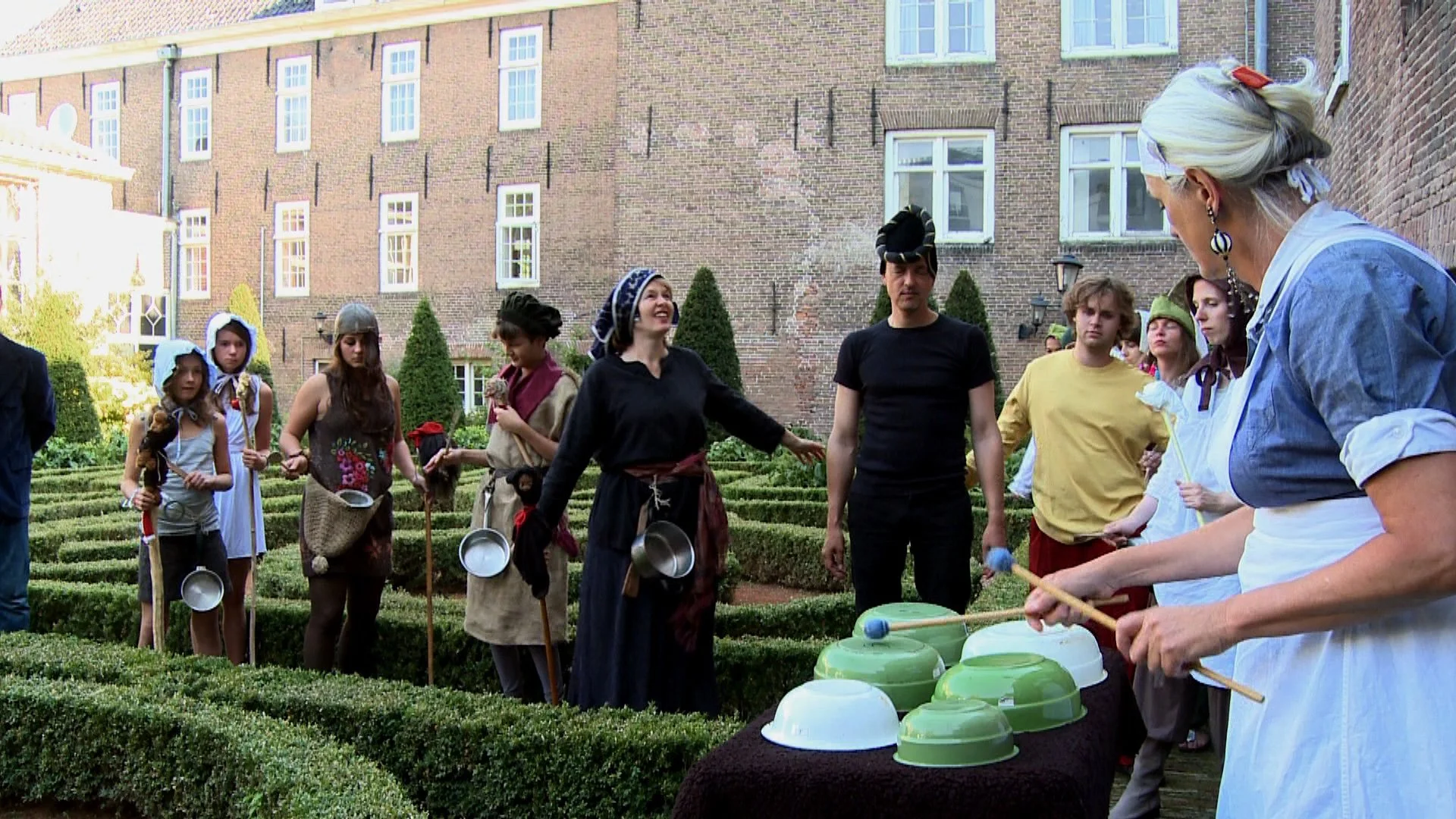
A LONG HISTORY OF MADNESS, 2011. The charivari in the garden of the Maison Descartes, Amsterdam — the crowd of the mad and those enacting madness as parody merge, moving to percussion played on upturned pots and pans by Laeticia Bal.
Courtesy of the artist.
Michael Ann Holly’s Somewhere Between Art History and Phenomenology: At the Still Point of the Painted World, discussed by Mieke Bal in this conversation.
Published by Edinburgh University Press, 2025.
MB: You put your finger on the right issue! Indeed, the theoretical claims are never self-evident, nor obviously relevant. In the video work I have produced, the theoretical claims are tested, and as you say, put under pressure. I never just want to “illustrate” them — the concept of illustration itself I reject, for the way it subordinates the narrative and/or theoretical content to something else, like an argument or a story. The noun “illustration” makes the speech — argument, story — produced by the maker more important than what the work, the art piece, does, whereas the “illustration” is only used to enhance the former and make the alleged illustration/example just a confirmation. This is a way of refusing the possibility that the art, the images, the text, can, as I call it, “speak back”, add to, correct, or change something in the primary line of argument or story-telling.
That idea that the piece of art, or its exhibition, can, even must, “speak back” involves a willingness, even eagerness, of the participants — themselves activated through their relationship and response — to facilitate the participation of the images, or their characters or adventures, as well.
This need for the “work of art” to “speak back” to the primary speaker — teacher, curator, or student — becomes especially important when we are facing the painful issue of trauma. I see trauma as socially produced, and therefore, in need of a social restoration of the broken bond. Let me advance one example, which is of the utmost actuality: take the harsh lives of refugees who, having left behind all that was dear to them, are now, lonesome. But in the busy city life of a crowd whose language they don’t speak, they are never entirely alone. Lonely but not alone: there is no more difficult life thinkable.
Madness can thus be seen as socially produced, if only because the foreigners are not addressed, not taken seriously as interlocutors. In a recent film I co-made with a young artist, Lena Verhoeff, that oppressive loneliness of the refugee is figured — to allude to the important key word French philosopher Jean-François Lyotard has proposed as “figuration” in his PhD thesis of 1971 — through the video takes conceived outside of the usual dialogue. There are two passages read by a voice-over, one from the Hebrew Bible, which is quite nasty: misogynistic and ethnocentric, and one from the Quran, which is, surprisingly for most people, deeply sympathetic and feminist. But the figures, the refugee and his bullies, and the people on the streets, do not speak at all. Silence, mocking, ignoring, refusing to look the refugee in the face: these are the trauma-inducing social ills.
All this can be considered — as Paris-based psychoanalyst Françoise Davoine does in her illuminating practice and abundant writings — as a social production of madness. And if madness is socially produced, the logical consequence is that society is responsible to cure it, to repair it — something Freud thought to be impossible. But through her thinking, writing, and practice, Davoine has proven him wrong. Thanks to her vision of trauma and the need for, and possibility of, helping the traumatised, we [Michelle Williams Gamaker and I] have been able to turn trauma and its curing into a narrative without a simple fabula.
CH: What I find compelling in Image-Thinking and in your films is that they function as sites where theoretical claims are put under pressure rather than simply illustrated. Across works such as Don Quijote, Mille et un jours, and A Long History of Madness, different strands of trauma, migration, and the social production of madness recur in different configurations — sometimes intersecting, sometimes receding. How do you decide, in the making, which of those strands will be allowed to surface most forcefully in a given project and which will remain latent?
“A medium is a vehicle, a means to do something, and in my film and video work that frequently results in stories, or at least, contents that seem to be narrative, or contain narrative fragments.”
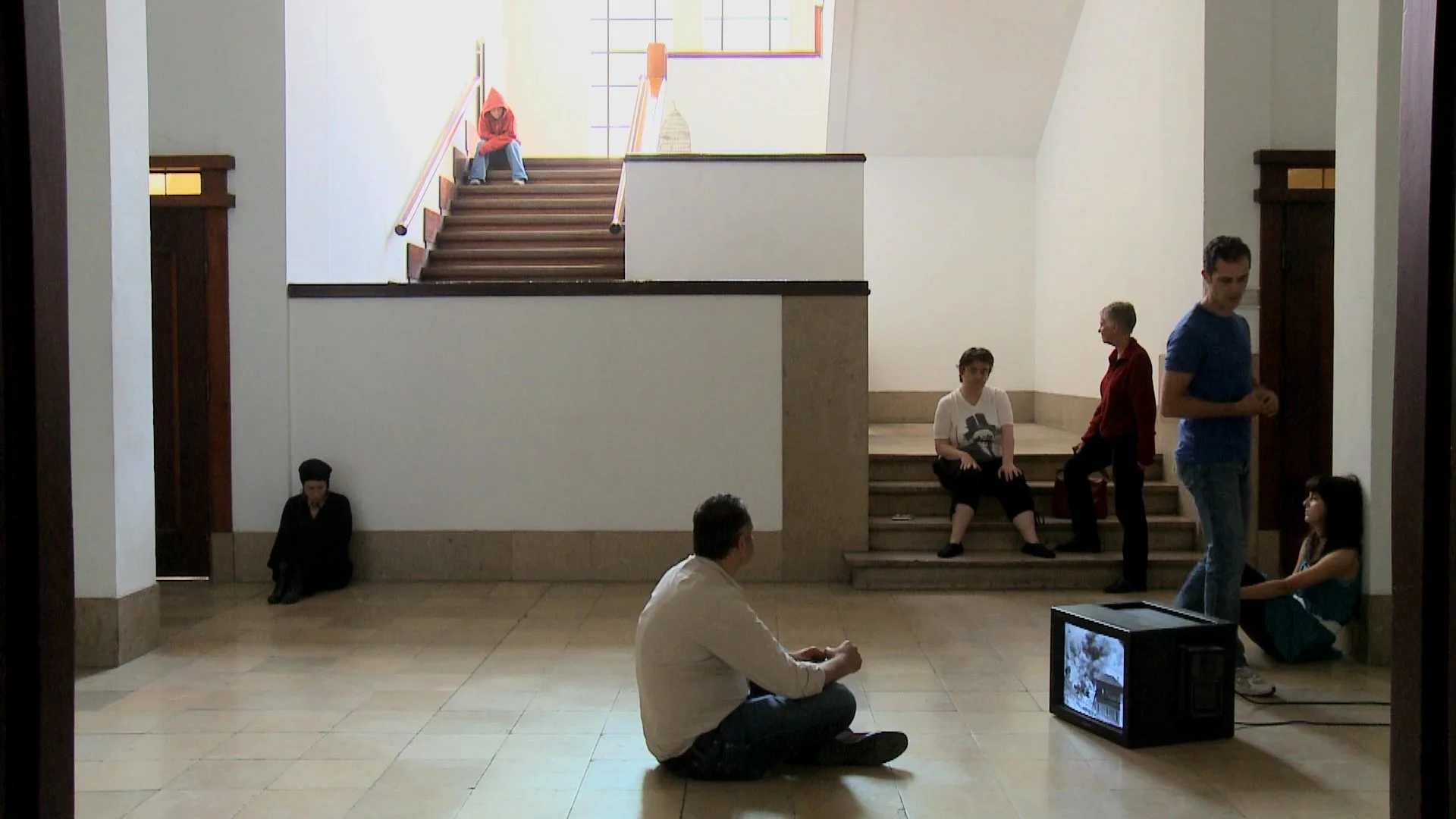
A LONG HISTORY OF MADNESS, 2011. Film-still showing patients dispersed through the hall of the hospital, each occupying the space separately.
Courtesy of the artist.
In making that film in 2011, in English, it’s titled A Long History of Madness, we followed the theoretical-analytical lead of Davoine. The traumatised characters [Sissi, Artaud, and others] are played by very gifted actors, and their appearances, small acts, and conversations clearly demonstrate the social aspect of their “madness”. Hence, the aspects of madness that we brought to surface in the film were selected by following the argumentation in the serious writing of the analyst.
The film still showing Françoise Davoine’s actual work as an analyst. She is talking with her patient, played by Thomas Germaine.
Saying It: an exhibition based on fragments of A LONG HISTORY OF MADNESS.
Installation view.
Courtesy of the artist.
MB: You are right to notice that trauma makes the form of narration as we are used to it problematic, and the phenomena you mention are very precisely noticed. “Interruption” is what makes the conversations hard to follow and be consistent, to stay with one topic. This becomes already clear in the first “theoretical fiction”, when the “patient” (played by Thomas Germaine) is making a hard effort to clarify to the analyst what bothers him and what had made his life difficult so far. Whenever Davoine brings up something, he interrupts her and comes up with his own view. When they sit together in her office, the conversation does not evolve simply and clearly. This is quite precisely the point. But it seems relevant that Davoine, the trauma-specialist, when she is abducted and brought to court in the film called Mère Folle, also keeps interrupting even the alleged judge, who is indicting her for her method.
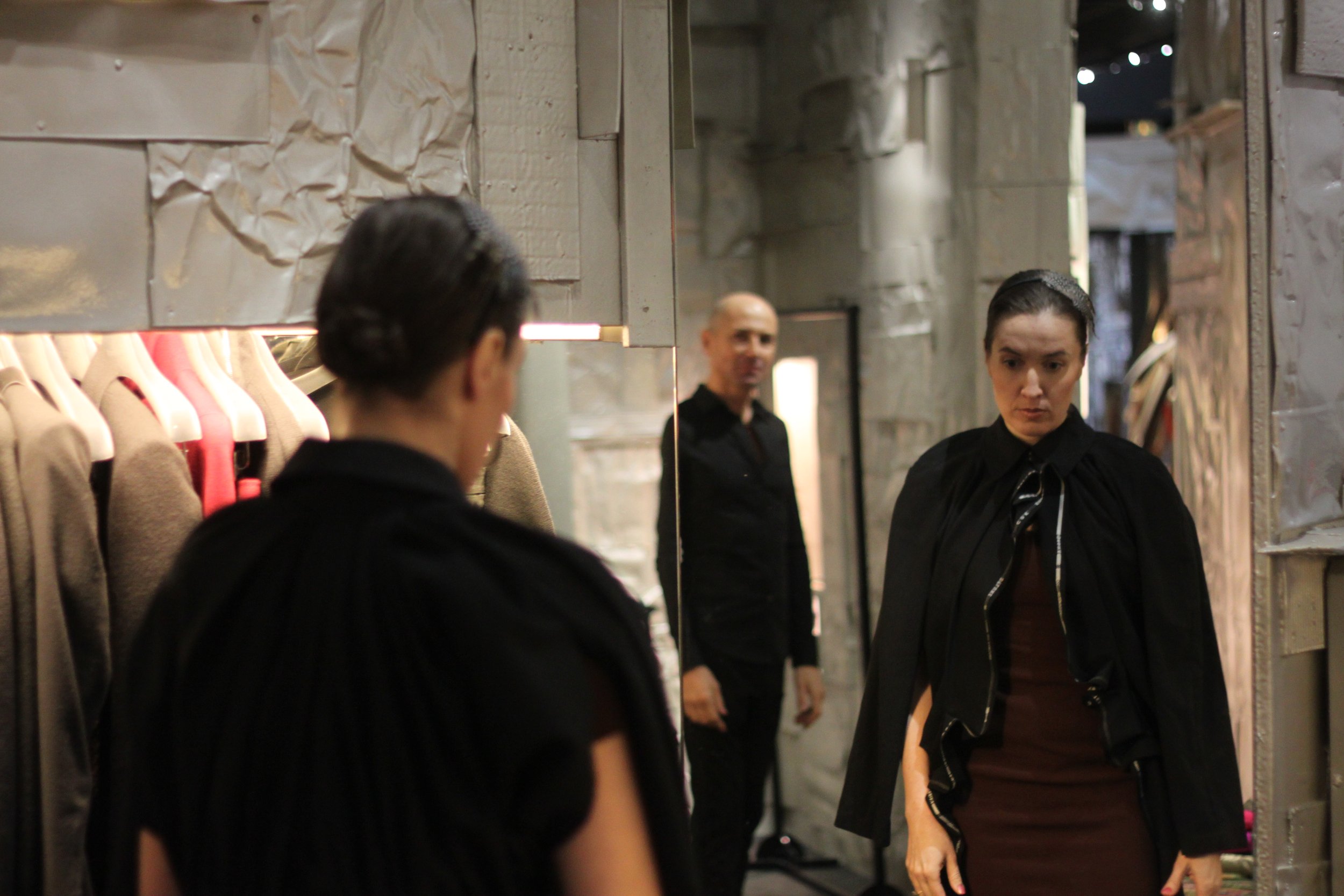
The second difficult element you mention, “repetition”, becomes particularly obvious in films such as Madame B: Explorations in Emotional Capitalism, our 2014 film, again made with Michelle Williams Gamaker, followed by 18-, 8- and 5-piece installations, in which we respond to, and actualise, Flaubert’s world-famous novel. For the title of that film, we avoided the name of the character, “Bovary”, to emphasise our interpretation, diverging from the original novel, and also to make the issue of emotional capitalism, so well theorised by sociologist Eva Illouz, relevant for today in the ongoing dominance of that issue in the world, without attributing it to one specific character. The photo of the main character being seduced into buying fancy clothes in a fashion shop shows on her face an insecurity, a hesitation, while also showing the seduction at work.
CH: In some of your films, trauma seems to alter the form of narration itself through interruption, repetition, dispersed voices, and non-linear narrative flow. Do you see these formal disruptions as ways of representing trauma or as evidence that trauma is actively reorganizing the film’s capacity to narrate just as how trauma reorganizes one’s own perception of life and society?
The third deviation you mention, “dispersal”, appears, and cannot really be avoided, in the films where a larger social group than the individual characters appear, act, and talk. This is especially obvious in the scene of A Long History of Madness where the crowd of the mad and the people enacting madness as a parody merge, and walk, run, and dance, responding to some of the lead characters who say harsh things about, for example, Lacan. And while they move around — in the garden of the Amsterdam-based Maison Descartes — they also seem taken by the percussion music performed with sticks on upturned pots and pans, by Laeticia Bal. This can be seen in photos from those scenes of dispersal, a few of which appear in a recently published small book in German devoted to the concept and practice of the essay in its multiple meanings: Über das Versuchen.
MADAME B: EXPLORATIONS IN EMOTIONAL CAPITALISM, 2014. Emma (Marja Skaffari) in the fashion shop, filmed at the Paris concept store L'Éclaireur. Cinematography: Christopher Wessels. Courtesy of the artist.“And if madness is socially produced, the logical consequence is that society is responsible to cure it, to repair it — something Freud thought to be impossible. But through her thinking, writing, and practice, Davoine has proven him wrong.”
When the narrative stops to flow, when the linearity is disrupted, the appearance of trauma, or rather, the traumatised, becomes central, rather than the events in the fabula. This is when trauma, as we can see it, over-rules narrative linearity. Of the films mentioned so far, this is quite clear. Especially in the installation Don Quijote: Sad Countenances, from 2019 [a 16-channel video installation, total duration 144’], where the actor Mathieu Montanier brilliantly plays the allegedly mad knight, we can see how following the bizarre, incoherent narrative of Cervantes’s novel yields a video installation of a similar incoherence, which is also clearly visible in the videos based on the six installations this piece has enjoyed.
As you ask in the final sentence of your question, my answer would be: “both”. The traumatic disruptions influence the films’ capacity to narrate, but also, as long as we are attentive enough to the social turbulence the trauma-induced madnesses cause, our own perception of life and society will inevitably change. This is how film and art can work to have an impact.
MB: Yes, Becoming Vera, a rather long experimental documentary from 2008, brings up the difficulties as well as the potential of a varied cultural heritage/citizenship. The experimental nature of the film comes from the different places where it is shot, the different people she comes in touch with, but also from the astounding fantasy the small child displays, especially in her storytelling. When we were filming, the incredibly smart little girl was able to negotiate that variation, thanks to her primary gift: her imagination. I have extensively written about her and the resulting film, so I don’t feel compelled to reiterate those views here.
The catalogue I wrote to accompany the exhibition in which the film appears, Art out of Necessity (Kunst uit noodzaak), a video-installation exhibition at Museum Jan Cunen in Oss, the Netherlands (3 October 2020 – 31 January 2021; was interrupted in mid-December by the second coronavirus lockdown), contains it all. The video about the exhibition made by Lena Verhoeff can be watched here.
Vera clearly demonstrates the difficulties, but also the possibilities, of modifying her sense of who she is through encounters with other cultural environments. In her case, the strong differences of cultures and of class, between her parents — the father a prince from Cameroon, the mother a Russian citizen — and her own growing up in Paris show up in particular in her imaginative storytelling. Through that activity she manages both to keep her parents and others riveted, and to come up with views, such as that of the flying-away fairy, and her own ballet classes, all of which enhance, rather than flatten, the variation of her cultural background. Although I have lost touch with the (divorced) parents, and also with the girl who is now a student at the University of Paris-Nanterre, my writing “Becoming the World versus Identity Politics” in Nordlit about her when I was making the film helps to answer your question.
Just to respond a bit more directly to your question: for me, the transplantation of a person, especially a young child, from one culture to which they are used to, to another one they do not yet know, will probably always cause some psychic/social turbulence, but this is not necessarily damaging. In Vera’s case, that temporary estrangement seems to have disappeared very quickly due to her skill in imagining stories — partly influenced by what parents or teachers have read to her, and what she sees and experiences in the new place — but she has also imagined her stories due to her rich fantasy, through which those already-known stories merge and become new ones.
CH: In Becoming Vera, we are irresistibly drawn to the little girl’s (Vera) multiple inheritances — Cameroonian ritual, French everyday life, the Pushkin lineage from her mother’s side in the era of Imperial Russia — and to the question of how she might negotiate the various cultural differences. If Vera was born and raised in Paris, France provides the stable social world within which her Cameroonian and Russian inheritances are encountered and negotiated. How do you weigh that against someone transplanted into another cultural and social order after a sense of belonging has already formed — as the consequence of political history reaching across generations? Does cultural citizenship describe both conditions equally well, or does the second require a different account of rupture and cultural translation?
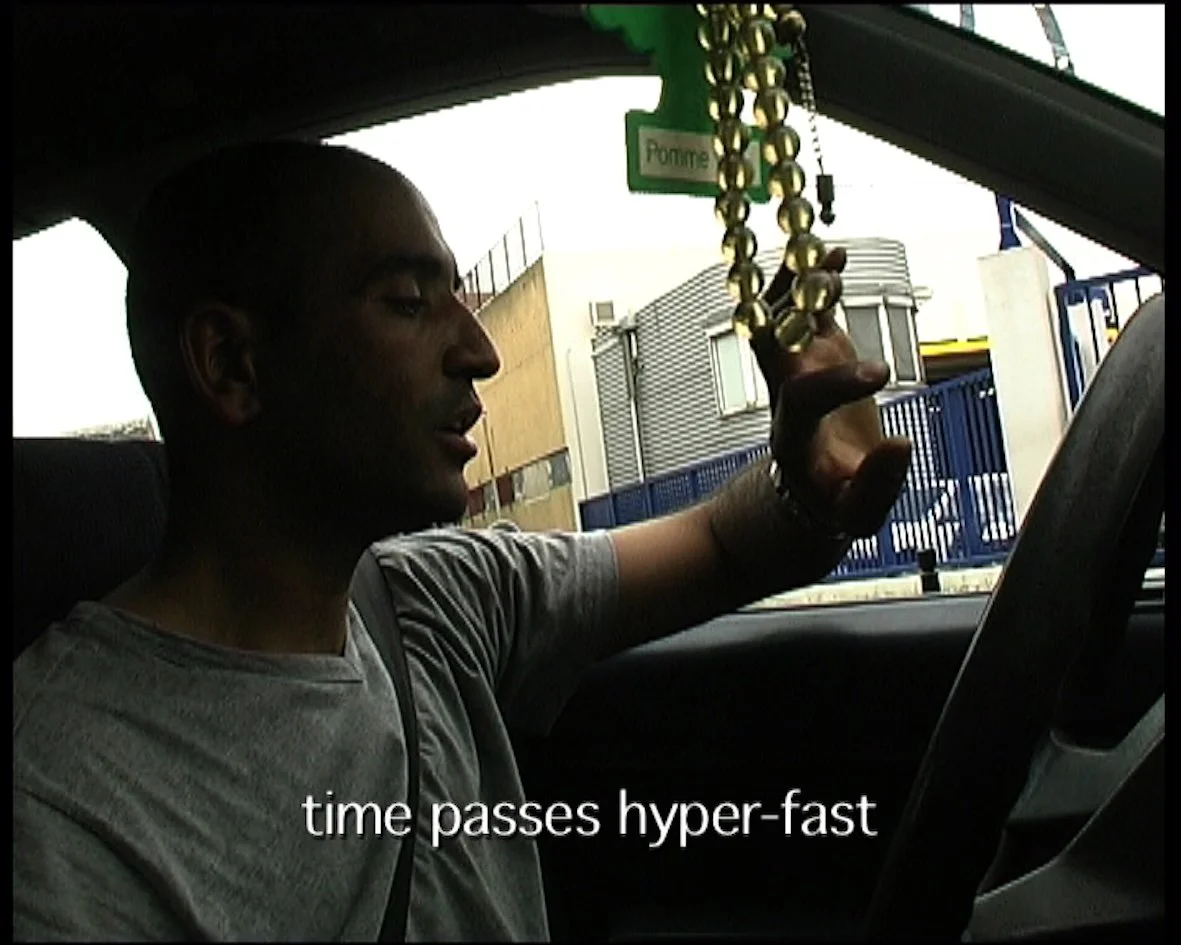
For me, to allude to one of your examples, the hybridity of temporality, in other words, the refusal of linear chronology, is, and has been for a long time, a necessity to understand cultural difference as not really “messy”, but acceptable, and even enriching. Rather than a sign of refusal to take a clear political position — which I always have done — the idea of cultural difference makes a clear political position more necessary, enriching, and important. Taking a political position is not only necessary, since without it we are totally indifferent to the world, but also helps to make trauma “curable”, to facilitate the restoration of the broken social bond that trauma seems to keep broken. Social behaviour is the necessary mode of “curing” trauma — of making it rememberable, which, outside of that reparation, it is not. Hence, what causes trauma is not what helps repair it, to put it simply. Hence, it is not the cultural “messiness” that traumatises people — the escape from which explains how Tarek and I could become such profound and lasting friends — but the cultural rejection of the consequent “madness”. The traumatised madness is, and will always be, unacceptable, and cannot be experienced, understood, or remembered.
What I have called “migratory aesthetics” is a vision of aesthetics, as what touches people, related to the migratoriness and the variation of cultural backgrounds we encounter in the world. I have always been enchanted by cultural differences, rather than, as is more usual, being frightened or disturbed by them. Seeing, or meeting, people who seem to be different, who speak different languages, and who have habits we don’t (yet) know is an enrichment; a way of getting to know “newness”; novelty—seeing, experiencing, something new, strange, unknown. To get to know what you didn’t know: how enriching! This is how encounters with people from different cultures help us feel inspired. In Mille et un jours, the basic experience was an encounter, an inter-ship; the novelty of what we did not know. The meetings with Tarek’s future wife, Ilhem, her parents, the mother and the father who thought they were essentially different from me and my world, and the uncle who we see feeding a baby in the film, again provide a new experience I didn’t know. This film, as a documentary, requires discretion, which is why we did not put it online as a whole.
MB: As different from Vera, the main character in Mille et un jours, named Tarek, was already an adult, a student at a Parisian university when we met, quite accidentally. One day, he just passed through the courtyard of our building with his arm in a cast. When I saw that, without knowing him, I had to ask what had happened to him, and when he began to explain what had occurred, I had to invite him in to hear the full story — which was gripping. This meeting was the beginning of the film, as well as of a life-long friendship. The simple fact that, as a Tunisian, he came from a very different culture was not a big issue with the two of us. Between him and me, the issue was to understand each other. Which we did, perfectly. Hybrid belonging, as you can call it, simply means that your background, history, and cultural habits come from a side that is different from my own traditional one. This is in itself exciting.
CH: When recounting the making of Mille et un jours, you touched on migratory aesthetics as a way of honoring the messiness of hybrid belonging, post-memory, and non-synchronous time. Yet messiness can also sometimes function as a protective stance for the filmmaker as a refusal to take a clear position on matters political and personal. How do you distinguish a politically responsible messiness from one that aestheticizes trauma while leaving the structures that produce it intact?
Tarek, the protagonist of MILLE ET UN JOURS. A student in Paris, he was earning a living and preparing the apartment for his wedding; he keeps looking at his watch.
Courtesy of the artist.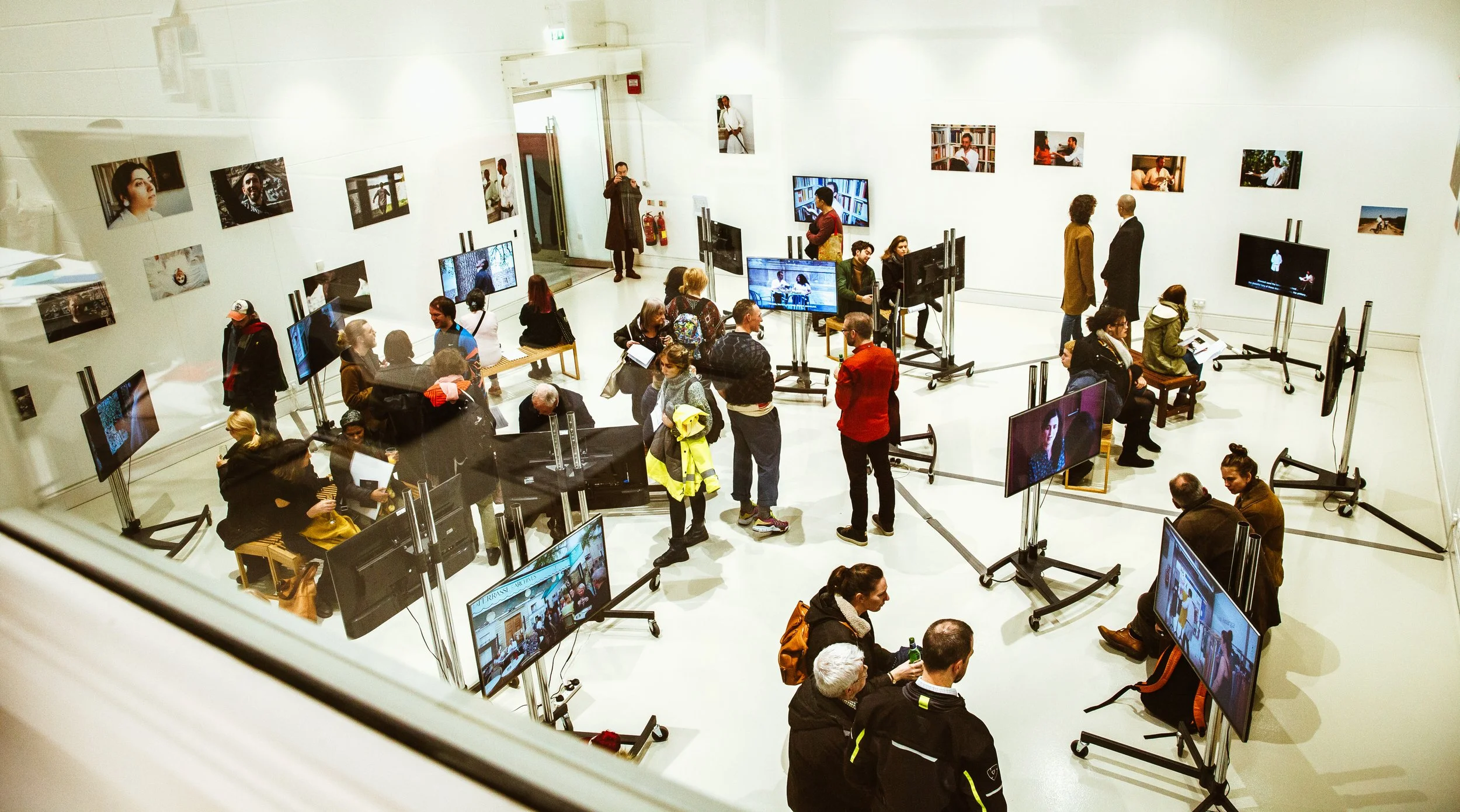
DON QUIJOTE: SAD COUNTENANCES, 2019. Installation view, Leeds Arts University Gallery (The Blenheim Walk Gallery), 7 January – 14 February 2020. Sixteen channels on mobile stands, set at varying heights and angles to avoid rows, with photographs from the project on the surrounding walls. Photograph: Memory Potifa.
Courtesy of the artist.
“… a way of getting to know “newness”; novelty—seeing, experiencing, something new, strange, unknown. To get to know what you didn’t know: how enriching! This is how encounters with people from different cultures help us feel inspired.”
MB: No, that is not what I meant. “Continuous” is not the right characterisation. They can change, move, diminish or aggrandise. The fact that Descartes had psychotic episodes, and given his biography, had good reasons for it, does not mean that he was constantly or essentially mad. The book written by Kyoo Lee analyses his alleged madness as also simply “bad” — and more; because the title of her book also says more: Reading Descartes Otherwise: Blind, Mad, Dreamy, and Bad attributes to him a good variety of features, all compatible but not identical. Lee’s book also insists on the fact that those features are the result of our reading; hence, the interpretation we, as readers, come up with is burdened by each reader’s background, knowledge, social life, and also, prejudices. The traditional dismissal of the philosopher (“we are post-Cartesian” is frequently said and written) is based on a meagre, simplistic interpretation of his writings, which Kyoo Lee undermines. Her book’s title recommends reading him “otherwise” than the habitual and cliché interpretations that make him, as you say, “the father of rationalism”. And if one person, such as Descartes, can move from rational to mad episodes, that simply means that his personality was in movement, depending on many factors in his life.
Hence, what you ask is more a clear description of the man, the person who helped Western culture to develop rational thinking, including episodes and reasons that made him waver. Traumatised: yes, we can assume that. His mother died when he was born and his father abandoned him early on, leaving him with his grandmother to pursue a career elsewhere. At least, that is what I gathered from the biographical information. As you write, these two personalities are, indeed, not “radically different”, but that means: not always, not permanently, but still, hampered with a constantly changing personality. Consequently, yes, let’s not fixate on him, or anyone, on permanent features, but accept that he and the other traumatised, “mad” people can change and move back and forth from one state to another. The film was made to demonstrate that moving quality of the character. When the psychoanalyst (the ‘soul doctor’) he consults on the advice of his friend Chanut insists too much on talking about his father, he runs away in fury.
CH: In a section of the last chapter called “For a Different Mode of Thinking,” in invoking that Descartes had psychotic episodes, you write that the traumatized mad and the father of rationalism are not radically different. If reason and madness are continuous — if the madness can be made to make sense — then does the category of madness dissolve, and must we refuse the binary altogether?
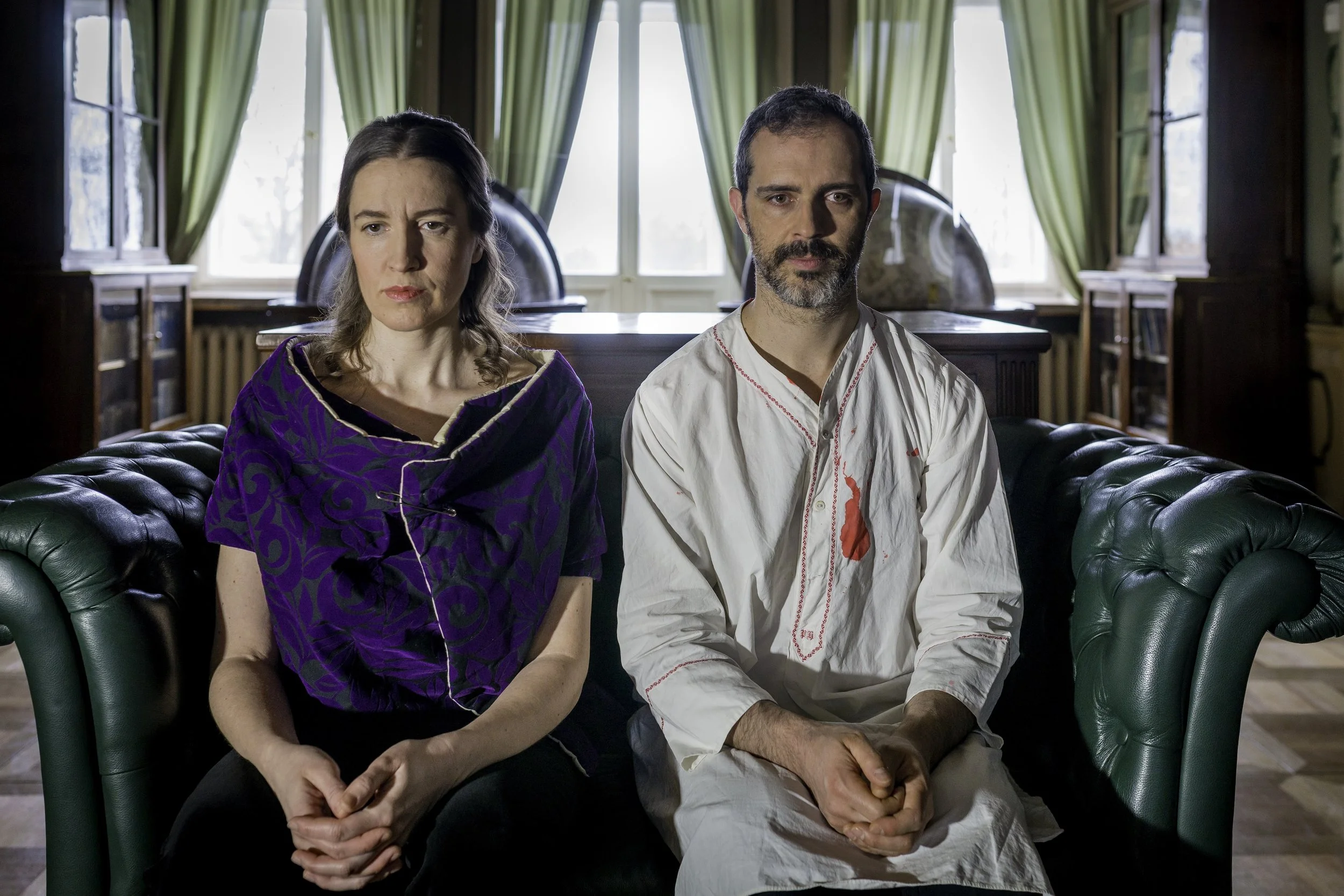
REASONABLE DOUBT: SCENES FROM TWO LIVES, docu-drama, theoretical fiction, 98’, 2016.
Descartes is played by Thomas Germaine, Kristina by Marja Skaffari; they re-meet after Descartes’s death.
Film-still courtesy of the artist.
MB: Probably, Davoine means that both media can help, and that madness is both an individual pathology and a socially caused rupture. She seems to mean that trauma-induced madness is an individual pathology indeed, but this is caused by the severing of familiar social bonds caused by others. And therefore, to help, to cure the traumatised mad people, it is necessary to accompany them within their mental state. They need that companionship, so that they are not entirely alone in their suffering. But keeping company is not the same as identifying. The analyst/helper does not need to be as mad as the traumatised; not at all. Holding hands, so to speak, is not the same as identifying, as “becoming” as mad as the patient. But in a sense, a certain potential to really “be with them” is helpful. Freud denied this is possible; he denied the potential to understand enough to be helpful. But Davoine starts at the other end: if society has traumatised the patient, then society is responsible to get them out of it. This sounds logical enough. But the transference necessary for this which Freud denied was possible, is, for Davoine and her colleagues, possible in the process of social (re-)bonding.
It is not the language that fails when a treatment does not work out. It is the social action of (re-)bonding that may falter. We have experimented with this issue. On my website there are two videos of exhibition tours about this, both based on the installation pieces made after the film A Long History of Madness. By the way, it is worth watching that film, because Davoine herself acts in it, playing her own role as an analyst. This works especially well when she addresses the patient played by Thomas Germaine, and the Finnish analyst who treats Sissi is also very effective, in a similar way, by provoking transference.
CH: Like Davoine, you do not frame madness purely as a pathology of the individual psyche, but as a severing of familiar social bonds through violence. For Davoine, the analytic task is not to impose reason from outside but to enter the sufferer’s mental landscape, where an episode of madness or severe breakdown may itself be an attempt to reveal and repair that rupture. My question is this: to truly understand without imposing, need one be, in some sense, as mad as the sufferer? If verbal language fails, might image-thinking do better?
If image-thinking works better than just verbal language is a good question. I tend to say “yes”, simply because my filmmaking brings the issues at stake up in a concrete, visible manner. I have begun to make videos and films for this reason. Showing, presenting what we can see as well as hear, will only work, however, if the filmmaking takes the psychoanalytical needs into account. This includes the need for transference. But film as a medium does not exclude linguistic utterances. Most films contain dialogue, or at least, voice-over readings.
MB: Indeed, the exchange between theoretical concepts and audio-visual presentation does not move in one direction. As I have amply discussed in my book Quoting Caravaggio: Contemporary Art, Preposterous History, that rejection of unilateral, linear thinking also, I can say, especially, holds for the issue of time. Chronology, as a linear view of time aiming to progress, is an untenable vision of history that puts the past far away. Instead, I have considered how chronology is mutual; the past and the present are exchangeable, as if in conversation.
This mutuality has consequences for the production of art pieces. Contemporary art responds to art from the past but does not simply imitate it. As the examples from Quoting Caravaggio demonstrate, recent art pieces are never simply “obedient” to the “model” from the past. On the contrary, they respond to it, frequently critically, offering changes in the conception of the older pieces. That is “critical quotationalism”, as I have called it. I have written an article in The Persistence of Melancholia in Arts and Culture (Routledge, 2019) on this issue.
However, I have no memory of a drastic revision of any of my theoretical positions in or through the practice of artmaking. But perhaps you notice a case; if you do, then please let me know. My concepts and theoretical reflections have always been meticulous, and from the beginning I have insisted on their theoretical precision. The book Travelling Concepts in the Humanities: A Rough Guide demonstrates the importance of such precision. Like the narratology book, this book is one of my most popular ones. Especially the concepts of image and metaphor are key to what I argue through that book.
CH: You repeatedly bring theoretical concepts into contact with your artistic practice, and the exchange does not seem to move in only one direction. Can you think of an instance in which making a film led you to revise or complicate a theoretical position you had previously held?

SISSI IN ANALYSIS, 2012. Thirteen-screen installation by Mieke Bal and Michelle Williams Gamaker in the exhibition SAYING IT, Freud Museum, London. Installation view. Courtesy of the artist.But your question addresses the film-making practice. For this, perhaps the comparison between our film Madame B: Explorations in Emotional Capitalism and Flaubert’s world-famous novel Madame Bovary, published in 1857, can illuminate the difficulty of film-making “after” a novel that is supposed to be an adaptation — which our film is not! — whereas it is, as I keep calling it, a “response”, a reaction to the novel, but with a critical differentiation from it, even if some similarities also matter. For this example, it matters that the syndrome of “emotional capitalism”, put forward, as I have mentioned, by the sociologist Eva Illouz, continues to reign, to rule the world.
This conversation is part of Axis of Culture’s Autumn 2026 issue exploring how cultural, social, and technological disruptions shape thought, creative practice, and the ways we interpret and inhabit the world.Chennie Huang is the Founder of Axis of Culture.